

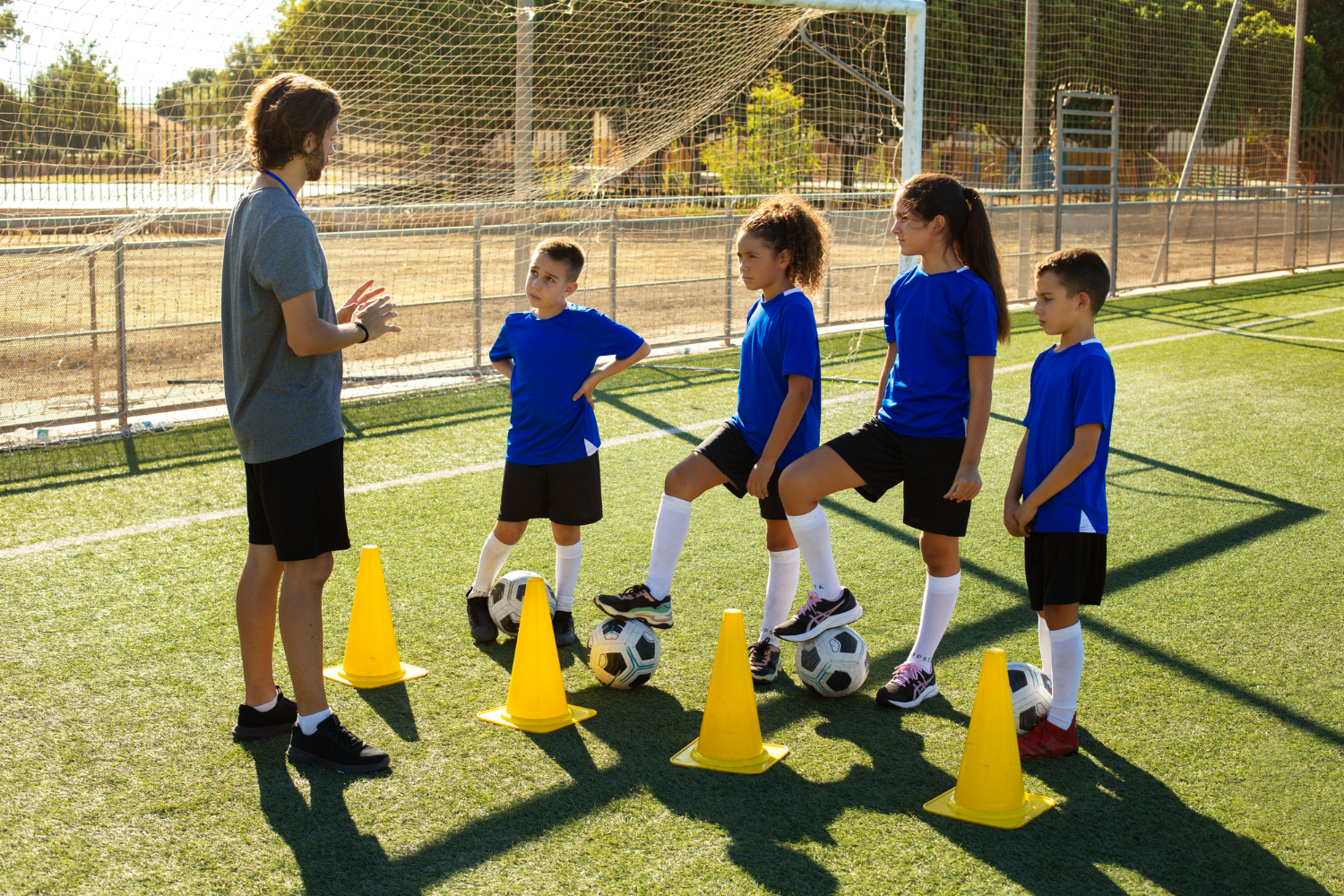
A school soccer session can put children with very different levels of experience on the same field. One student may already know how to dribble, pass, and shoot. Another may be touching a soccer ball for the first time.
That difference can make participation tricky.
For schools considering soccer programs for schools, the challenge isn’t simply getting students onto the field. It’s creating sessions where beginners can learn without feeling lost, while confident players still have enough to work on. We take an age-based approach to instruction, with activities that can be adjusted as players gain experience.
Why Mixed Skill Levels Matter
Children don’t all start soccer for the same reason. Some already play outside school. Others join because they want to try a new activity or because their friends are participating.
A single group can therefore contain a wide range of abilities.
Beginners Need Room to Learn
A child who is new to soccer may need more time to understand how to control the ball or follow a simple passing activity. If the pace moves too quickly, that child can spend more time watching than playing.
Early success matters. Being able to stop the ball, make a short pass, or dribble around a marker can give a beginner a reason to keep trying.
Confident Players Need a Bigger Challenge
Experienced players have a different problem. Repeating an activity they’ve already mastered can become boring.
They may be ready to make quicker decisions, work in tighter spaces, or combine skills during a game. The answer isn’t necessarily to remove them from the group. A coach can change the difficulty while keeping everyone involved in the same session.
One Activity Can Serve Different Players
Consider a simple dribbling exercise.
A beginner might have a larger area and fewer obstacles. A more experienced player could navigate a smaller space or respond to changing instructions. Everyone is practicing ball control, but the level of difficulty isn’t identical.
That approach gives children a chance to progress without turning every difference in ability into a separate class.
How Inclusive Soccer Sessions Can Work
The coach plays a major role in making this approach work.
A youth soccer coach can watch how children respond to an activity and make small adjustments as the session develops. One child might need another demonstration. Another might need a more difficult version.
Those changes don’t have to interrupt the entire class.
Our curriculum is designed around different stages of childhood development, taking age and developmental needs into account rather than using one format for every young player.
For schools, this can make soccer more approachable for students who haven’t had much previous exposure to the sport.
Keeping Students Involved From the Start
Participation can drop when children feel that they are either struggling constantly or not being challenged.
The solution can be surprisingly simple. Give students achievable tasks, then adjust those tasks as their confidence changes.
A beginner who is learning to dribble might first focus on keeping the ball close. Once that becomes easier, the coach can add direction changes or another player to the activity.
A confident player might begin with the same basic movement and then be asked to make decisions under greater pressure.
Progress doesn’t always require a completely new drill. Sometimes it just requires changing one part of the challenge.
Why Bringing Soccer to School Can Help
Where an activity happens can influence whether families can realistically take part.
We work with schools and early childhood organizations and offer programming that can fit into recess, PE, enrichment, after-school schedules, and school-out periods.
That can remove one of the practical hurdles associated with youth sports. Instead of adding another trip to the weekly family schedule, students can participate where they already spend much of their day.
For schools, an on-site soccer program can also be planned around the school’s existing timetable and facilities.
That practical side matters. A program can be well designed and still be difficult for families to use if the logistics don’t work.
Giving Confident Players Somewhere to Go Next
An introductory school program shouldn’t have to be the end of a child’s soccer experience.
A student who starts as a beginner may become interested enough to want more practice. Another student may already be looking for a greater challenge.
We offer different stages of programming. Super Soccer Stars focuses on foundational soccer skills, while Soccer Stars United is intended for players ready for more advanced technical development and team concepts.
This type of progression gives children room to move forward as their interest and ability change.
A student doesn’t have to start as a strong player to find a place in the program.
What Makes Soccer Stars Different?
At Soccer Stars Huron Valley, school soccer is built around the idea that children can enter the sport at different points and still have meaningful opportunities to participate.
The Huron Valley program serves different age groups and highlights trained coaches, low child-to-coach ratios, and age-appropriate programming.
The school offering also provides several scheduling options. Depending on the school, soccer can be incorporated into recess, PE, enrichment, after-school programming, or school-out camps.
That flexibility is useful because a preschool and an elementary school won’t necessarily have the same schedule, space, or student needs.
The program needs to fit the school, not create another scheduling problem for it.
What Schools Should Ask Before Starting
Before selecting soccer programs for schools, administrators should consider how the provider handles different levels of experience.
A few practical questions can help:
- How are activities adapted for beginners and experienced players?
- Are coaches trained to work with the age group being served?
- Can the program fit into the school’s existing schedule?
- What options are available for students who want to continue after an introductory program?
These questions shift the conversation away from simply asking whether soccer can be offered and toward whether the program will work for the students who actually participate.
We allow schools to request programming based on factors such as age group, program type, and preferred start date. Our school offerings include before-school, after-school, recess, PE, and holiday or summer programs.
That gives administrators a practical starting point for fitting soccer into the school environment.
Making Room for Every Player
The goal of school soccer isn’t to make every student perform at the same level.
A beginner may be working on basic ball control while a confident player is learning to make faster decisions. Both can participate in the same sport while working toward different next steps.
That requires thoughtful coaching and activities that can be adjusted without making students feel singled out.
At Soccer Stars Huron Valley, that approach gives schools a way to introduce soccer to children who are new to the sport while continuing to challenge students who already have experience.
For schools evaluating soccer programs for schools, the important question is whether the program gives different kinds of players a reason to stay involved. When beginners can build confidence and experienced players can keep developing, the field becomes a place where more students can participate.
Conclusion
Mixed skill levels are part of almost every school sports setting. They don’t have to become a barrier.
Beginners need room to learn. Confident players need opportunities to keep improving. With the right coaching approach, one school soccer session can make space for both.
That means a student doesn’t have to arrive knowing the game to belong on the field. They simply need an appropriate place to start and a clear opportunity to keep moving forward.
