

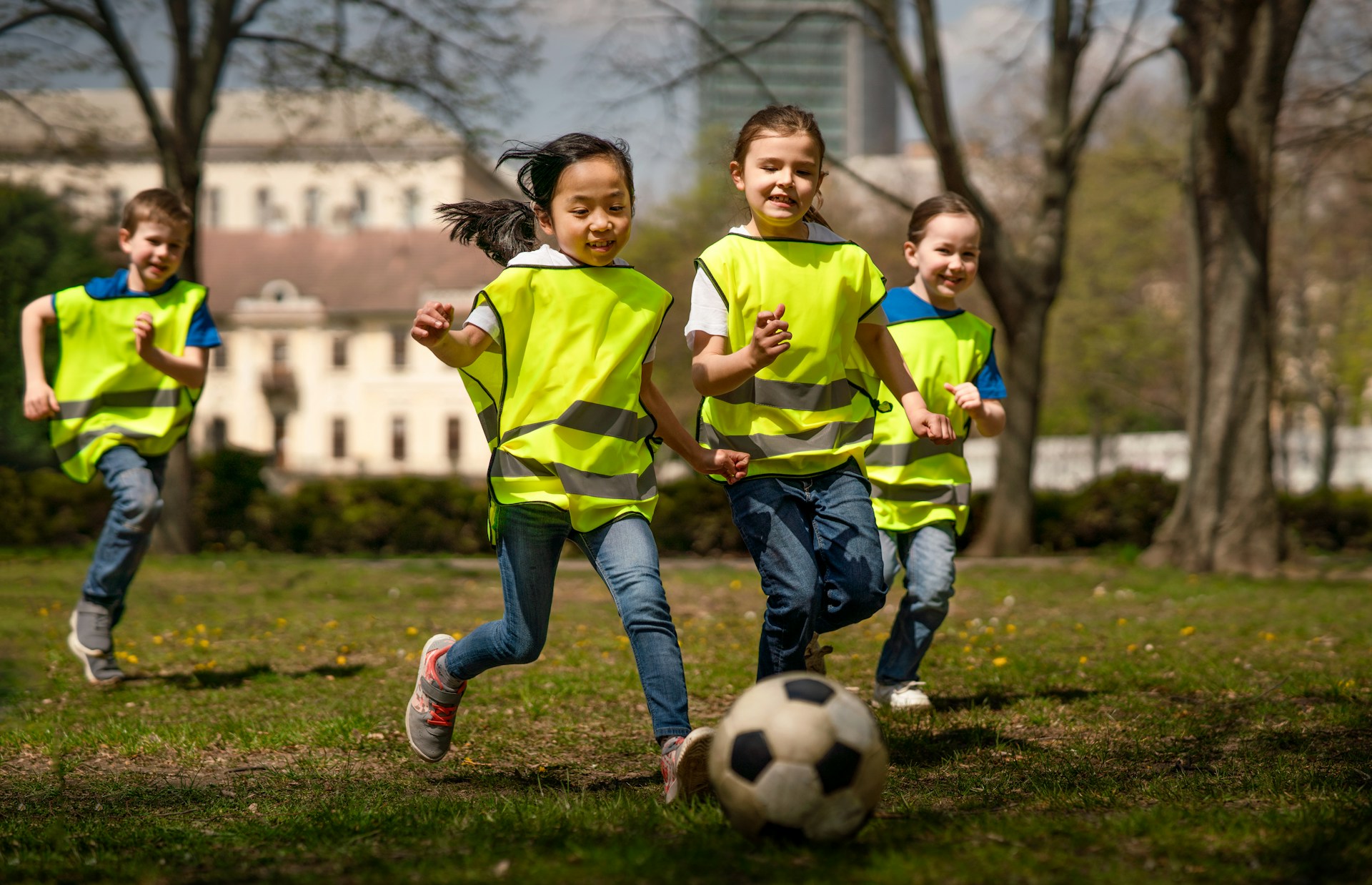
A child can spend months kicking a ball around the backyard before anyone needs to talk about “training.” At first, the goal is simple: run, kick, chase the ball, and have fun. Then something changes. Your child starts trying to dribble around you, asks how to make a better pass, or wants to play the same game again because they almost got it right.
That can be a sign that they’re ready for more direction.
For parents looking for kids soccer classes in Canton, the question isn’t really about finding the most advanced program. It’s about knowing when playful soccer should become more organized instruction, and whether the next step matches the child’s development.
There is no single age when that switch should happen. Some children want more coaching early. Others need more time to become comfortable with the ball and group activities.
The first clue may have nothing to do with skill
Parents often watch for technical milestones. Can my child dribble? Can they pass? Can they shoot?
Those are useful questions, but interest can tell you just as much.
A child who starts asking how to do something differently is showing a different kind of readiness. Maybe they want to know why the coach asked them to move somewhere. Maybe they keep practicing the same turn after class. Maybe they notice that passing to a teammate creates a better chance to score.
That’s the point when soccer starts becoming a problem they want to figure out.
The child doesn’t need to be highly skilled before that happens.
Look for these changes
Readiness can show up in small ways during a class, at home, or during a casual game:
- They repeat skills on their own. A child who keeps working on a dribble or shot may be ready for more specific instruction.
- They can follow a short sequence. Listening to an instruction, trying it, then adjusting the movement is a useful foundation for structured coaching.
- They begin looking up. Instead of watching only the ball, they start noticing teammates, open space, or where the coach wants them to go.
- They want another challenge. If your child finishes an activity and immediately asks to try something harder, pay attention.
- They enjoy small games. A child who begins making simple decisions during play may be ready for more technical and tactical ideas.
None of these means a child needs competitive soccer. They simply suggest that the child may be ready for a different kind of learning.
Structured training doesn’t have to mean serious competition
This is where parents can get mixed signals.
“More structured” can sound like longer practices, pressure to perform, or a jump into a competitive team. For young children, it doesn’t have to mean any of those things.
Good structure can be much simpler.
A coach introduces a skill. The child gets a chance to practice it. The activity changes slightly. Then the skill appears inside a game.
That last part matters. Young players need opportunities to use what they’ve learned rather than spending an entire session repeating a movement with no connection to the game.
For families considering kids soccer classes in Canton, Soccer Stars’ approach follows that progression. Super Soccer Stars teaches fundamental soccer skills in a fun, non-competitive, educational environment. Soccer Stars United Development is designed as the next stage, gradually introducing technical skills, tactical elements, and team concepts as players reach program milestones.
So the move forward doesn’t have to feel like leaving childhood soccer behind. The instruction simply becomes more involved.
Age matters, but readiness matters too
A six-year-old who has played soccer for two years won’t necessarily be ready for exactly the same experience as another six-year-old who has never joined a class.
That is one reason age-specific curriculum matters.
We offer programs across different stages, from Parent & Me for toddlers through Super Soccer Stars and Soccer Stars United Development. The Huron Valley program currently lists Super Soccer Stars for ages 2.5 to 10 and Soccer Stars United for ages 5 to 12.
The age ranges provide a starting point. The child’s behavior and experience help fill in the rest.
A parent doesn’t need to decide, “My child is now an advanced player.” A more useful question is, “What does my child seem ready to learn next?”
That keeps the focus on development rather than labels.
What makes Soccer Stars different at this stage?
For a young player, the coach can make a bigger difference than the name of the drill.
We use an age-specific curriculum and trained coaches, with a low child-to-coach ratio listed among our program features. Our Huron Valley location also describes our classes as non-competitive and designed to support soccer skills, confidence, and socialization.
That combination matters during the transition to structured training.
A coach can introduce more demanding activities without turning every mistake into a problem. A child can try a new technique, lose the ball, try again, and gradually figure out what works.
That’s especially useful when children are still developing coordination and learning how to participate in a group.
At Soccer Stars Huron Valley, the pathway also gives families a place to go when a child begins looking for more than foundational instruction. Soccer Stars United Development is specifically positioned as a continuation of Super Soccer Stars, rather than a completely unrelated program.
What happens when the child is ready?
The next stage should add layers to the game.
A child who once focused on getting the ball from one side of the field to the other may begin learning how to protect it from a defender. Passing can become a decision rather than a simple technique. Shooting can involve choosing a target instead of just kicking toward the goal.
Team concepts begin to make sense too.
- Where should I move after I pass?
- Can I create space for another player?
- What happens when we lose the ball?
These are small questions, but they change the way a child sees soccer.
Our United Development focuses on individual techniques, using skills at speed, and helping players develop confidence while gradually adding tactical and team concepts.
That makes the progression easier to understand. The child isn’t simply doing harder drills. They’re learning to make more decisions while playing.
What if your child isn’t ready?
Don’t rush it.
A child can stay with foundational soccer for a while and still make progress. More structure isn’t automatically better if the child isn’t interested or doesn’t yet have the attention and coordination for it.
Sometimes the best next step is another season of playing, experimenting, and becoming comfortable with the ball.
The useful thing about a progression-based program is that parents don’t have to force that decision early. They can watch how their child develops and move forward when the fit makes sense.
For parents searching for kids soccer classes in Canton, that distinction is worth keeping in mind. The goal isn’t to move a child into the highest level as quickly as possible. It’s to find instruction that gives them something new to work on without taking away their reason for showing up in the first place.
The right time is when the game starts raising new questions
There may never be one obvious morning when your child wakes up and is suddenly “ready for structured training.”
Usually, it happens gradually.
The child starts repeating a skill. They notice teammates. They ask why a play worked. They want another turn. They become interested in what happens beyond simply chasing the ball.
Those moments are worth noticing.
We give families a progression from foundational instruction into more advanced development, with age-specific programming and a gradual introduction to technical, tactical, and team concepts.
At Soccer Stars Huron Valley, that progression can give a child room to stay playful while taking the next step when they’re ready.
For a Canton family, that’s the real decision: not how quickly a child can advance, but whether the next class gives them a reason to keep learning.
